
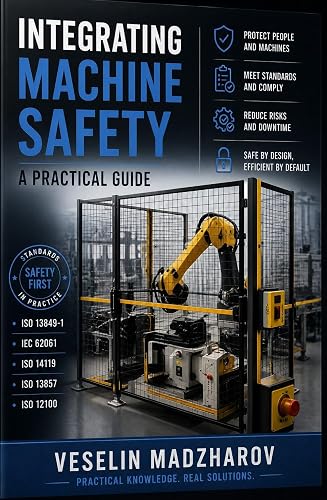
Safety Integration Machine
Machine Safety Integration – Technical Manual
Machine safety is not created by installing a safety relay or adding an emergency-stop button. Effective protection depends on how hazards are identified, how safety functions are designed, and how sensors, logic devices, contactors, drives, and machine controls work together as one verified system.
Machine Safety Integration is a practical, engineer-focused manual for understanding how modern machine safety functions are implemented, connected, tested, and validated. Through clear explanations, logical diagrams, and realistic industrial scenarios, the book shows how to develop safety systems that protect personnel without creating unreliable operation, unnecessary machine stops, or unsafe restart conditions.
WHO THIS BOOK IS FOR
This book is written for:
• Industrial electricians and maintenance technicians
• Automation and control engineers
• Machine builders and panel designers
• PLC and safety-PLC programmers
• Commissioning and service specialists
• Machine-safety technicians and risk-assessment professionals
• Engineering students and technical trainees
• Anyone responsible for modifying or maintaining industrial machinery
WHAT YOU WILL LEARN
Inside this book, you will learn how to:
• Understand the purpose and structure of machine safety systems
• Convert identified hazards into practical safety functions
• Integrate emergency stops, guard switches, light curtains, and safety sensors
• Understand the roles of safety relays and safety PLCs
• Separate standard control logic from safety-related control functions
• Design safe stop, reset, restart, and manual acknowledgement sequences
• Prevent unexpected machine movement after a safety device is reset
• Monitor contactors, valves, drives, and other final switching devices
• Use feedback circuits to detect welded or failed contacts
• Understand redundancy, diagnostics, and fault detection
• Integrate safety functions with PLCs, drives, robots, and machine controls
• Recognize common wiring and logic mistakes
• Test individual devices and complete safety functions
• Document verification results and functional tests
• Diagnose safety-related machine stops systematically
• Improve existing machines without creating new hazards
TECHNICAL AREAS COVERED
The manual examines the main devices, circuits, and engineering concepts used in modern machine safety integration, including:
• Emergency-stop circuits
• Guard doors and safety interlocks
• Safety limit switches and coded sensors
• Light curtains and presence-sensing devices
• Two-hand control systems
• Safety relays and programmable safety controllers
• Dual-channel input circuits
• Contactor and actuator feedback monitoring
• Safe reset and restart logic
• Manual and automatic reset arrangements
• Safety contactors and final switching devices
• Drive and motor stopping functions
• Pneumatic and electromechanical energy isolation
• Fault detection, redundancy, and diagnostic coverage
• Safety-related wiring and electrical panel integration
• Functional testing and commissioning procedures
• Troubleshooting of safety circuits and intermittent faults
• Modification, verification, and documentation of existing machines
WHY THIS BOOK MATTERS
A machine may appear to stop safely while still containing stored energy, failed contacts, bypassed sensors, incorrect reset logic, or an uncontrolled restart path. These weaknesses are often hidden until maintenance work, a component failure, or an operating error exposes them.
Written in a clear, concise, and manufacturer-neutral style, this manual provides a structured reference for designing, commissioning, testing, and troubleshooting safer industrial machines.