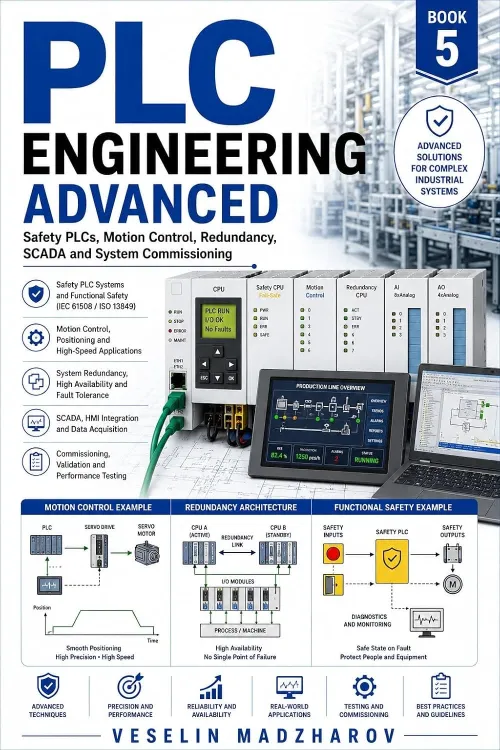

PLC Engineering
Industrial Networks for PLC Systems: PROFINET, PROFIBUS, Modbus, EtherNet/IP, IO-Link and Remote I/O
Series: PLC Engineering Series
Industrial automation depends on reliable communication. A PLC program may be correct and every field device may be functional, yet production can still stop because of a duplicate IP address, damaged connector, missing termination, configuration mismatch, timeout, excessive traffic, unstable topology, or electromagnetic interference.
PLC Engineering: Industrial Networks for PLC Systems is a practical guide to designing, configuring, commissioning, and troubleshooting communication networks used in modern factories and automated machinery. It explains how PLCs, remote I/O stations, drives, sensors, HMIs, SCADA systems, robots, and intelligent field devices exchange data—and how to find the real cause when that communication fails.
WHO THIS BOOK IS FOR
This book is written for:
• Automation and control engineers
• PLC programmers and commissioning specialists
• Industrial electricians and maintenance technicians
• Machine builders and system integrators
• Network and plant-support professionals
• Technical students and trainees
WHAT YOU WILL LEARN
Inside this book, you will learn how to:
• Understand industrial Ethernet and fieldbus communication
• Follow cyclic and acyclic data exchange between devices
• Select star, line, ring, tree, and redundant topologies
• Configure and diagnose PROFINET systems
• Work with PROFIBUS addressing and termination
• Understand Modbus TCP and Modbus RTU communication
• Diagnose EtherNet/IP connections and device status
• Integrate IO-Link devices and remote I/O stations
• Identify duplicate addresses and configuration conflicts
• Find packet loss, unstable links, and communication timeouts
• Diagnose damaged cables, poor connectors, and missing termination
• Evaluate shielding, grounding, and electromagnetic interference
• Use switch counters, event logs, and timestamps
• Preserve evidence before restarting a failed network
• Separate network faults from PLC logic or field-device problems
• Improve segmentation, access control, backup, and recovery
TECHNICAL AREAS COVERED
The book examines the main protocols, components, topologies, and diagnostic methods used in industrial communication systems, including:
• PROFINET and PROFIBUS
• EtherNet/IP
• Modbus TCP and Modbus RTU
• IO-Link and distributed remote I/O
• PLC, HMI, SCADA, drive, robot, and sensor communication
• IP addressing, device names, node addresses, and configuration files
• Cyclic and acyclic data exchange
• Managed industrial switches and diagnostic counters
• Star, line, ring, tree, and redundant network structures
• VLANs, segmentation, and controlled engineering access
• Cable, connector, termination, grounding, and shielding faults
• Packet loss, link instability, timeouts, and stale data
• Communication alarms, recovery behavior, and event correlation
• Network security, backups, remote support, and recovery planning
WHY THIS BOOK MATTERS
Intermittent communication faults are among the most difficult industrial problems because they may disappear after a restart. Resetting the system can restore production while erasing the evidence needed to understand the failure.
This book presents a structured diagnostic method: verify the physical layer, preserve device status, compare timestamps, inspect switch data, review configuration, and test each possible cause before replacing equipment.
Written in a clear, manufacturer-neutral style, PLC Engineering: Industrial Networks for PLC Systems is both a learning guide and a practical field reference for building networks that remain connected, maintaina