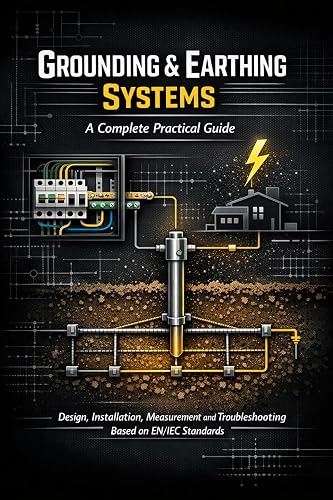

GROUNDING & EARTHING SYSTEMS
Modeling, Fault Currents, GPR, Touch/Step Voltage, Industrial EMC & Real Accident Cases
Series: Grounding & Earthing Series
Grounding and earthing systems behave very differently under real electrical stress than they do in simplified calculations. During short circuits, lightning events, insulation failures, and high-energy faults, current spreads through conductors, structures, soil layers, and parallel metallic paths, creating voltage gradients that may place people and equipment at serious risk.
Grounding & Earthing Systems – Volume 2 examines these conditions through practical engineering analysis. It explains how grounding grids respond to fault current, why ground potential rise develops, how touch and step voltages appear, and how soil properties, bonding, corrosion, and industrial interference influence system performance.
WHO THIS BOOK IS FOR
This book is written for:
• Electrical and power-system engineers
• Industrial electricians and maintenance technicians
• Substation and plant-design professionals
• Electrical safety specialists and consultants
• Commissioning and testing engineers
• Renewable-energy and infrastructure professionals
• Technical students seeking deeper grounding knowledge
• Anyone investigating grounding or EMC problems
WHAT YOU WILL LEARN
Inside this volume, you will learn how to:
• Understand fault-current distribution through grounding networks
• Analyze ground potential rise during high-energy events
• Evaluate touch and step voltage hazards
• Understand current flow through different soil layers
• Recognize dangerous voltage gradients around electrodes and grids
• Evaluate grounding-grid behavior during short circuits and lightning
• Identify parallel current paths through structures, pipes, shields, and bonding conductors
• Understand how corrosion changes grounding resistance over time
• Recognize unexpected bonding effects and circulating currents
• Separate safety-grounding problems from EMC and noise problems
• Select and apply practical measurement methods
• Interpret test results beyond ideal theoretical assumptions
TECHNICAL AREAS COVERED
The book examines the main phenomena, calculations, measurements, and failure modes associated with industrial grounding systems, including:
• Fault current and current-sharing paths
• Ground potential rise
• Touch and step voltage
• Soil resistivity and multilayer soil behavior
• Grounding grids, rods, conductors, and electrodes
• Substation and industrial-plant grounding
• Lightning-current dissipation
• Bonding of structures and exposed conductive parts
• Parallel paths through steelwork, piping, shields, and cables
• Corrosion and long-term resistance change
• Ground loops, common-mode noise, and industrial EMC
• Renewable-energy and high-risk industrial installations
• Resistance, continuity, and potential-gradient measurements
• Analytical models, diagrams, formulas, simulations, and case studies
WHY THIS BOOK MATTERS
A grounding system may pass a simple resistance test and still create dangerous conditions during a real fault. Safe design requires more than a low measured resistance. It requires understanding where current will flow, how ground potential will change, and which conductive paths may carry unexpected current.
Combining engineering theory with accident analysis and practical field reasoning, this volume helps readers evaluate grounding systems under the conditions that matter most. It is a focused reference for design, testing, compliance review, failure investigation, and corrective action.
Grounding & Earthing Systems – Volume 2 is part of the Grounding & Earthing Series, dedicated to electrical safety, soil behavior, and real-world grounding engineering.