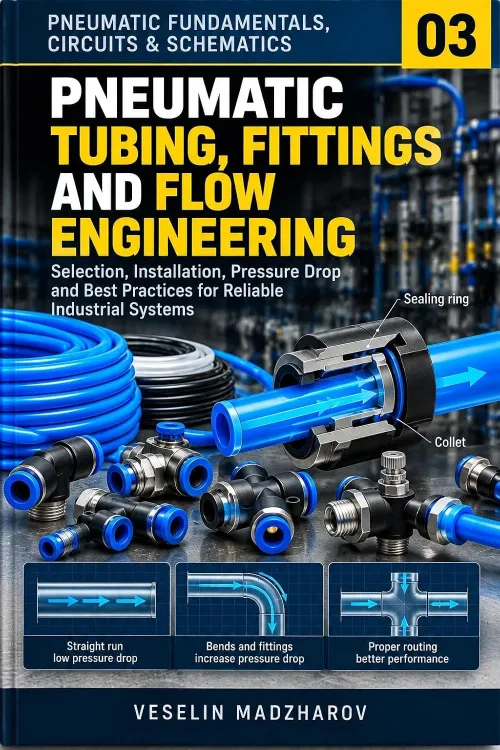
PNEUMATIC TUBING, FITTINGS AND FLOW ENGINEERING
Selection, Installation, Pressure Drop, and Best Practices for Reliable Industrial Systems (PNEUMATIC FUNDAMENTALS, CIRCUITS & SCHEMATICS Book 3)
Series: Pneumatic Fundamentals, Circuits & Schematics
The right tubing and fittings can make the difference between a reliable pneumatic machine and one that repeatedly loses pressure, slows down, leaks air, and wastes energy.
A pneumatic system may have a correctly sized compressor, properly adjusted regulators, and high-quality valves, yet still perform poorly. The problem often lies in overlooked details: restricted internal passages, undersized tubing, excessive line lengths, unsuitable fittings, poor routing, and uncontrolled pressure losses.
PNEUMATIC TUBING, FITTINGS AND FLOW ENGINEERING is a practical engineering guide to understanding, selecting, installing, and troubleshooting the connections that carry compressed air through industrial machinery.
Written for maintenance technicians, mechanical engineers, automation specialists, machine builders, and technically minded readers, this book connects essential engineering principles with real-world industrial applications.
WHAT YOU WILL LEARNPneumatic tubing materials: Understand polyurethane, polyamide, polyethylene, and fluoropolymer tubing, including their characteristics, limitations, and selection considerations.
Tubing dimensions and flow capacity: Learn why outside diameter alone does not determine airflow and how internal bore affects velocity, resistance, and pressure loss.
Industrial pneumatic fittings: Explore push-in connections, threaded fittings, sealing methods, internal restrictions, and correct installation practices.
Pressure drop and flow engineering: Understand how line length, internal diameter, bends, valves, and fittings influence dynamic pressure and machine performance.
Cylinder performance: Examine how supply pressure, exhaust restrictions, tubing volume, and flow controls affect actuator speed and response.
Manifolds and shared air distribution: Understand the effects of simultaneous actuator demand and restrictions in common supply lines.
Installation and routing: Discover practical methods for tube cutting, bending, support, strain relief, mechanical protection, and reliable connections.
Engineering calculations: Work with practical examples involving internal tube area, air volume, pressure measurements, and effective cylinder areas.
This is not simply a catalog of pneumatic components.
The book explains why pneumatic connections fail, how apparently minor restrictions affect entire machines, and what engineers should examine before replacing expensive components or increasing supply pressure.
Technical illustrations, explanatory diagrams, and practical engineering examples help connect theory with actual maintenance and machine-building decisions.
The emphasis is on clear reasoning, correct component selection, efficient troubleshooting, and long-term system reliability.
WHO SHOULD READ THIS BOOK?Industrial maintenance and service technicians
Pneumatic and mechanical engineers
Industrial automation specialists
Machine designers and equipment builders
Technical students and vocational trainees
Professionals responsible for compressed-air efficiency and machine reliability
Every pneumatic connection influences the performance of the system around it.
A fitting with an unexpectedly narrow passage, a poorly prepared tube end, or an unnecessarily long working line can create problems that appear elsewhere in the machine.
Stop treating pneumatic tubing as a minor installation detail.