
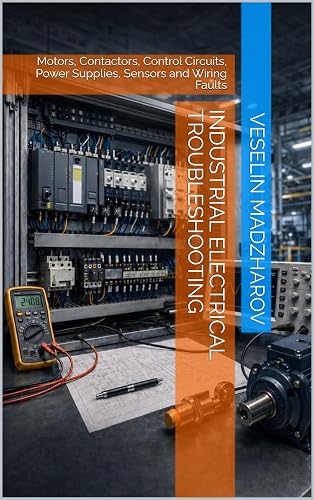
INDUSTRIAL ELECTRICAL TROUBLESHOOTING: Motors, Contactors, Control Circuits, Power Supplies, Sensors and Wiring Faults
Series: Industrial Troubleshooting
Industrial electrical faults do not arrive with labels. They appear as stopped machines, tripped protection, missing signals, overheated motors, chattering contactors, and urgent production pressure.
Industrial Electrical Troubleshooting is a practical, evidence-based guide to diagnosing faults in real machines and production equipment. Instead of relying on random part replacement, repeated resets, or fault-code guessing, it teaches a disciplined method:
Understand the expected sequence. Find where it stops. Measure the correct electrical boundary. Prove the root cause. Repair it. Verify the complete machine.
WHO THIS BOOK IS FOR
This book is written for:
• Industrial electricians and maintenance technicians
• Electrical and automation engineers
• PLC and commissioning specialists
• Service engineers and machine builders
• Electromechanical technicians
• Technical students preparing for factory work
WHAT YOU WILL LEARN
Inside this book, you will learn how to:
• Read electrical drawings while a machine is under fault conditions
• Divide complex circuits into smaller testable sections
• Select measurements that answer specific diagnostic questions
• Diagnose motors that will not start, overheat, trip, or lose torque
• Test contactor coils, power poles, and auxiliary contacts
• Diagnose 24 VDC supplies, transformers, fuses, commons, and overloaded circuits
• Test proximity sensors, photoelectric sensors, limit switches, analog signals, and encoders
• Separate PLC I/O faults from field wiring and device failures
• Diagnose solenoids, brakes, relays, valves, and actuators
• Identify loose terminals, damaged connectors, broken conductors, leakage, and grounding faults
• Separate VFD supply, command, drive, cable, motor, and load problems
• Capture intermittent faults caused by heat, vibration, moisture, timing, or movement
• Distinguish electrical faults from mechanical and process problems
• Verify that repairs restore both operation and protection
• Convert repeated failures into preventive actions
TECHNICAL AREAS COVERED
The book examines the main circuits, components, measurements, and failure mechanisms found in industrial equipment, including:
• Three-phase motors and motor-control circuits
• Contactors, overloads, relays, fuses, and transformers
• 24 VDC control-power and distribution systems
• Sensors, switches, analog signals, and encoders
• PLC digital and analog inputs and outputs
• Solenoids, brakes, valves, and electromechanical actuators
• Variable-frequency drives and motor cables
• Voltage, current, resistance, continuity, and signal measurements
• Voltage drop, connection resistance, leakage, grounding, and shielding
• Intermittent, thermal, vibration-related, and movement-dependent faults
• Root-cause analysis, repair verification, and failure prevention
WHY THIS BOOK MATTERS
A visible symptom often points toward the wrong component. A motor fault may begin in a damaged contactor pole. A failed PLC input may come from a missing sensor reference. A control-power problem may appear only when several coils energize together. An overload trip may be protecting the motor correctly from a mechanical problem.
Every major topic follows a practical structure:
SYMPTOM → PRINCIPLE → CIRCUIT PATH → MEASUREMENTS → EVIDENCE → ROOT CAUSE → REPAIR → VERIFICATION → PREVENTION
Written in a clear, manufacturer-neutral style, this book replaces assumptions with controlled testing and evidence.
A good troubleshooter is not the person who changes parts fastest. It is the person who can prove what failed, explain why it failed, restore the system safely, and prevent the fault from returning.
Industrial Electrical Troubleshooting is a practical, evidence-based guide to diagnosing faults in real machines and production equipment. Instead of relying on random part replacement, repeated resets, or fault-code guessing, it teaches a disciplined method:
Understand the expected sequence. Find where it stops. Measure the correct electrical boundary. Prove the root cause. Repair it. Verify the complete machine.
WHO THIS BOOK IS FOR
This book is written for:
• Industrial electricians and maintenance technicians
• Electrical and automation engineers
• PLC and commissioning specialists
• Service engineers and machine builders
• Electromechanical technicians
• Technical students preparing for factory work
WHAT YOU WILL LEARN
Inside this book, you will learn how to:
• Read electrical drawings while a machine is under fault conditions
• Divide complex circuits into smaller testable sections
• Select measurements that answer specific diagnostic questions
• Diagnose motors that will not start, overheat, trip, or lose torque
• Test contactor coils, power poles, and auxiliary contacts
• Diagnose 24 VDC supplies, transformers, fuses, commons, and overloaded circuits
• Test proximity sensors, photoelectric sensors, limit switches, analog signals, and encoders
• Separate PLC I/O faults from field wiring and device failures
• Diagnose solenoids, brakes, relays, valves, and actuators
• Identify loose terminals, damaged connectors, broken conductors, leakage, and grounding faults
• Separate VFD supply, command, drive, cable, motor, and load problems
• Capture intermittent faults caused by heat, vibration, moisture, timing, or movement
• Distinguish electrical faults from mechanical and process problems
• Verify that repairs restore both operation and protection
• Convert repeated failures into preventive actions
TECHNICAL AREAS COVERED
The book examines the main circuits, components, measurements, and failure mechanisms found in industrial equipment, including:
• Three-phase motors and motor-control circuits
• Contactors, overloads, relays, fuses, and transformers
• 24 VDC control-power and distribution systems
• Sensors, switches, analog signals, and encoders
• PLC digital and analog inputs and outputs
• Solenoids, brakes, valves, and electromechanical actuators
• Variable-frequency drives and motor cables
• Voltage, current, resistance, continuity, and signal measurements
• Voltage drop, connection resistance, leakage, grounding, and shielding
• Intermittent, thermal, vibration-related, and movement-dependent faults
• Root-cause analysis, repair verification, and failure prevention
WHY THIS BOOK MATTERS
A visible symptom often points toward the wrong component. A motor fault may begin in a damaged contactor pole. A failed PLC input may come from a missing sensor reference. A control-power problem may appear only when several coils energize together. An overload trip may be protecting the motor correctly from a mechanical problem.
Every major topic follows a practical structure:
SYMPTOM → PRINCIPLE → CIRCUIT PATH → MEASUREMENTS → EVIDENCE → ROOT CAUSE → REPAIR → VERIFICATION → PREVENTION
Written in a clear, manufacturer-neutral style, this book replaces assumptions with controlled testing and evidence.
A good troubleshooter is not the person who changes parts fastest. It is the person who can prove what failed, explain why it failed, restore the system safely, and prevent the fault from returning.
 ADVANCED INDUSTRIAL ROOT CAUSE ANALYSIS: Real Machine Failures, Diagnostic Evidence, Corrective Actions and Failure Prevention
 INDUSTRIAL AUTOMATION TROUBLESHOOTING: PLC, HMI, SCADA, Drives, Networks and Control-System Diagnostics