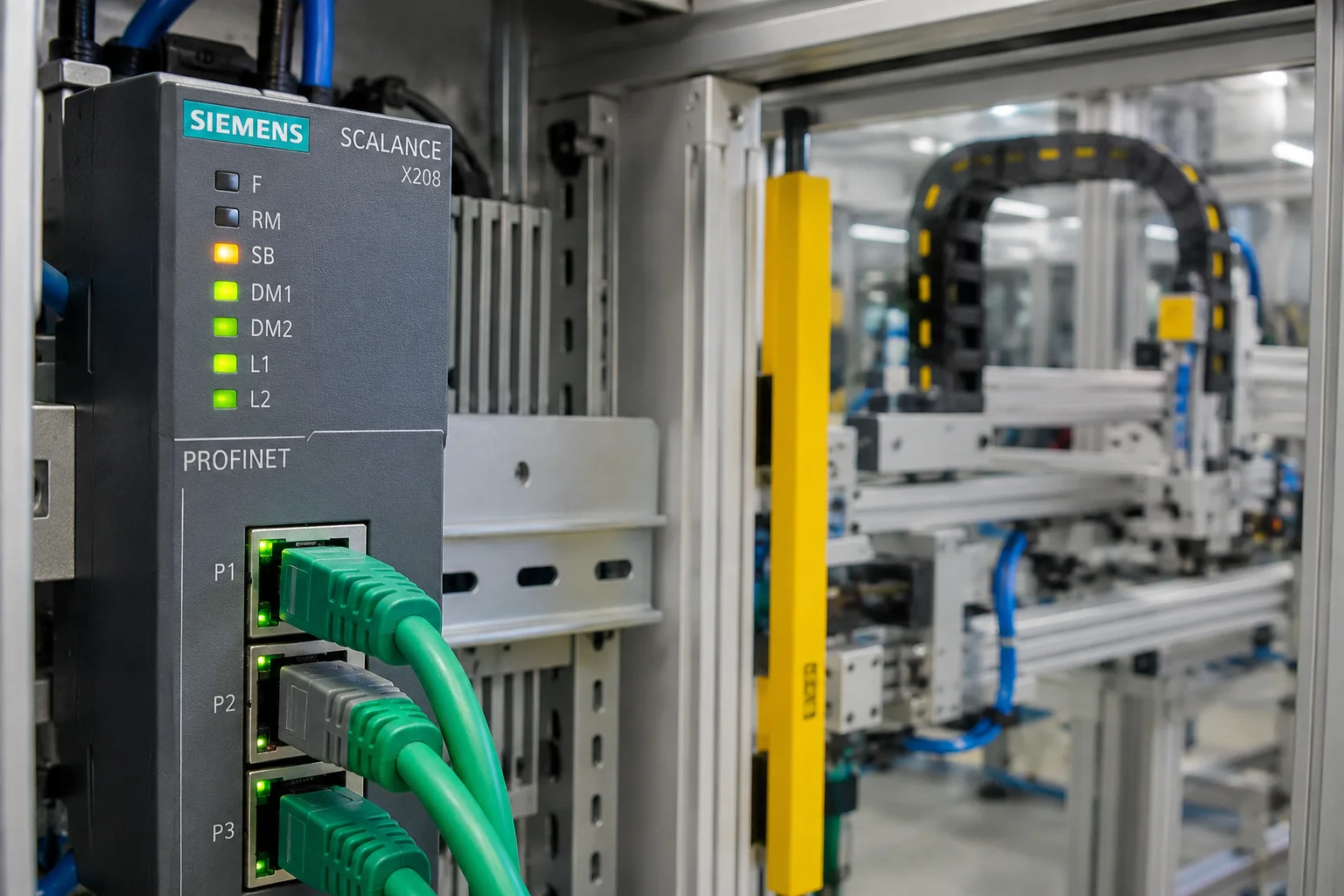
# Why Does a PROFINET Device Disconnect When a Machine Moves?
A practical engineering guide to intermittent industrial Ethernet faults, moving cables, remote I/O failures, and network diagnostics.
By Veselin Madzharov
The machine runs perfectly while standing still.
The PLC communicates with every remote I/O station. The network switch reports an active connection. There are no visible communication errors.
Then the moving carriage travels toward the end of its stroke.
A remote I/O station disappears.
The PLC reports a communication fault, the automatic sequence stops, and production calls maintenance.
A technician restarts the station. Communication returns immediately.
The machine is tested without movement. Everything works.
The fault is declared intermittent.
But intermittent does not mean unpredictable.
When a communication failure repeatedly follows a mechanical movement, the movement itself becomes valuable diagnostic evidence.
The challenge is determining whether the actual problem is the Ethernet cable, a connector, the device's power supply, electromagnetic interference, or an entirely different part of the automation system.
1. A communication alarm does not automatically mean a network failure
A PROFINET device can become unavailable for several reasons.
Some involve the physical communication network. Others have nothing to do with damaged Ethernet conductors.
Consider a remote I/O station mounted on a moving section of a packaging machine.
The station depends on several conditions:
- Adequate electrical power.
- Correct device configuration.
- A functioning physical Ethernet connection.
- A stable communication path.
- A functioning controller-device relationship.
If any necessary condition is lost, the controller may report a communication failure.
For example, an interruption in the station's 24V supply can produce a result that looks similar to a disconnected network cable.
Both conditions may cause the controller to lose communication with the device.
However, the required corrective actions are completely different.
The first diagnostic objective is therefore to distinguish an actual Ethernet link disturbance from a device interruption or a higher-level communication problem.
2. The hidden weakness of moving Ethernet cables
Industrial machines frequently include cables that move thousands of times during normal operation.
Examples include:
- Robotic handling systems.
- Packaging machine carriages.
- Automated assembly equipment.
- Conveyor transfer mechanisms.
- Moving inspection stations.
- Cable carriers and drag chains.
An Ethernet cable suitable for stationary installation is not necessarily suitable for continuous movement.
PROFINET installation guidance distinguishes several copper-cable types according to their intended mechanical application.
| Cable type | Intended application |
|---|---|
| Type A | Fixed installation without movement |
| Type B | Flexible installation with occasional movement or vibration |
| Type C | Dynamic applications involving repeated movement, such as cable carriers |
Specialized robotic applications may also require cables designed for combined bending and torsional loading.
The cable's permitted bending radius, motion characteristics, tensile loading, and environmental compatibility must be evaluated using the actual manufacturer's documentation.
A cable can be electrically functional when stationary and unreliable during movement.
This is one reason that replacing a damaged cable with another cable of the same unsuitable construction may produce only a temporary improvement.
3. Why the fault appears only at one machine position
Cable damage does not always produce a permanent open circuit.
Mechanical movement can change the stress applied to a cable or its termination.
A partially damaged conductor, compromised connector, or inadequate strain-relief arrangement may behave differently as the machine moves.
In one position, the physical connection may support normal communication.
In another position, mechanical stress may coincide with signal degradation or loss of link.
The failure can then appear at approximately the same position during each cycle.
This pattern is useful evidence, but it is not proof that the cable itself has failed.
Other conditions may also change with machine position:
- Electrical connections inside a moving assembly.
- Sensor or actuator power consumption.
- Mechanical vibration.
- Cable routing relative to interference sources.
- The operating state of devices attached to the carriage.
The investigation must distinguish these possibilities.
A repeated fault position is a starting point for diagnosis, not a substitute for it.
4. Understanding what the network diagnostics are telling you
Different diagnostic events point toward different types of failure.
A properly documented investigation should separate physical-link information from higher-level controller alarms.
Physical link loss
If a switch or device reports that its Ethernet port lost link, the evidence points toward a physical connection problem, device-port interruption, or loss of device power.
This narrows the investigation but does not identify a specific defective component.
Increasing communication errors
Some managed switches and Ethernet devices provide error counters.
An increase in physical-layer error counters can suggest a communication-quality problem.
However, error counters must be interpreted correctly for the particular hardware. Not every device exposes the same information.
Device restart
If a remote station reports a restart or its diagnostic history indicates supply interruption, the electrical power path deserves attention.
A power problem can produce a network alarm without a defective network cable.
Controller connection timeout
A controller may report that expected cyclic communication has been lost.
This identifies a communication failure from the controller's perspective.
It does not, by itself, prove whether the cause was cable damage, a device restart, network congestion, a switch problem, or another interruption.
The distinction matters because a network timeout is frequently a consequence rather than the initiating event.
5. A realistic industrial case: the carriage that stops at the same position
Consider an automated handling machine.
A remote I/O module is installed on a moving carriage. It communicates with the PLC through an industrial Ethernet network.
The module controls and monitors several field devices.
During normal production, the carriage travels repeatedly between two positions.
After months of operation, the machine develops an intermittent fault.
At first, the communication failure occurs only occasionally.
Later, operators notice that it happens most frequently near one end of the carriage travel.
Maintenance records show the following sequence:
Movement command → carriage travels → communication interruption → PLC sequence stops
The remote I/O station reconnects after the machine stops.
The first assumption
Because the PLC reports a network fault, the remote I/O module becomes the suspected component.
A replacement is considered.
However, historical diagnostics indicate that the Ethernet connection itself occasionally disappears during carriage movement.
The investigation therefore focuses on the physical communication path and its mechanical environment.
The important finding
An engineering inspection reveals that a section of the communication cable was not specified for repeated movement in the installed cable carrier.
The mechanical routing also places excessive bending stress on a particular section of the cable.
Under the appropriate isolated and safe maintenance conditions, the installation is evaluated against the manufacturer's requirements.
The resulting corrective action uses a cable suitable for the dynamic application, with an appropriate routing and strain-management arrangement.
After approved maintenance work, production-cycle monitoring confirms that the original link interruptions no longer occur.
This is an illustrative factory scenario, not a documented failure from a particular installation.
The central lesson is straightforward:
A network fault can originate in mechanical design.
Replacing an electronic module cannot correct a cable installation that is unsuitable for the machine's movement.
6. Why a successful ping test does not prove that PROFINET is healthy
A common diagnostic mistake is treating a successful ping response as proof that an industrial Ethernet system is functioning correctly.
Ping can confirm that a device responds to a particular IP-based network test at the time of testing.
That is useful, but limited.
A successful ping does not establish that:
- The connection remains reliable during movement.
- Cyclic PROFINET data exchange is functioning correctly.
- The device configuration matches the controller's expectations.
- The connection is free from intermittent interruptions.
- The system meets its required communication timing.
A device may respond to ordinary diagnostic traffic while a specific control-system communication relationship remains unavailable.
Likewise, an intermittent failure may disappear before a manual network test begins.
The investigation must therefore use diagnostic information appropriate to the actual industrial protocol, controller, network equipment, and event being investigated.
For PROFINET systems, relevant evidence may include controller diagnostics, device status, physical-port information, topology information, and recorded communication events.
7. The overlooked 24V supply problem
Not every movement-related communication fault is caused by Ethernet wiring.
A remote I/O station may share its power distribution with other equipment installed on the moving assembly.
If the available supply voltage becomes inadequate, the station may restart or temporarily cease operation.
The PLC then reports that communication with the station has been lost.
The alarm is correct: communication has failed.
But the initiating cause may be electrical power.
This distinction becomes particularly important when a machine movement also activates actuators, valves, brakes, or other electrical loads.
The movement event may coincide with both mechanical cable stress and changing electrical demand.
An evidence-based investigation compares available supply diagnostics with communication events before assigning the failure to either cause.
8. Electromagnetic interference: possible, but not the default explanation
Industrial Ethernet systems operate in environments containing motors, drives, switching devices, and power cables.
Electromagnetic compatibility is therefore an important part of network design.
However, it is a mistake to attribute every intermittent communication fault to electromagnetic interference.
The investigation should consider:
Mechanical factors: inappropriate cable construction, movement-related damage, connector stress, or inadequate routing.
Electrical supply factors: device power interruptions, voltage losses, or local distribution faults.
Communication factors: physical link changes, configuration problems, errors, or device behavior.
EMC factors: cable routing, bonding, shielding, and interference generated by nearby equipment.
An EMC-related explanation becomes more convincing when the recorded failure consistently correlates with a relevant electrical event and other competing explanations have been evaluated.
Simply observing that a VFD is installed nearby does not prove that it caused the communication problem.
9. A practical diagnostic evidence table
The following observations can help organize a maintenance investigation.
| Observed behavior | Possible area of investigation |
|---|---|
| Link disappears at a repeatable carriage position | Moving cable, connector, mechanical stress |
| Device restarts without corresponding link-error history | Supply or device power problem |
| Errors increase during certain drive operating states | EMC, routing, or physical-layer condition |
| One remote I/O station disappears | Local device, power, connector, or network segment |
| Several devices beyond one switch disappear | Shared upstream connection, switch, or supply |
| Ping succeeds but PLC communication remains faulty | Protocol configuration or cyclic communication |
| Fault disappears after restarting equipment | Intermittent or persistent underlying cause still requires investigation |
The table is intended to guide reasoning, not to replace appropriate diagnostic equipment or manufacturer procedures.
10. Why repeated restarts make troubleshooting harder
Restarting a device is sometimes necessary as part of an approved recovery procedure.
However, restarting equipment before preserving diagnostic evidence can remove information that would help identify the original fault.
Depending on the device and system configuration, useful information may include:
- Event timestamps.
- Port status changes.
- Device restart records.
- Controller diagnostic entries.
- Network switch counters.
- Recorded changes in device availability.
The information should be retained and correlated with the actual machine operating cycle whenever possible.
A repeated restart may restore production temporarily without correcting a damaged cable, inadequate power supply, or unsuitable installation.
Recovery is not the same as root-cause elimination.
11. Designing networks for moving industrial equipment
Reliable communication in moving machines begins during engineering design.
A suitable installation considers more than data rate and connector type.
Important requirements include:
Application-appropriate cable selection. The expected movement, bending, torsion, and environment determine the cable requirements.
Correct mechanical routing. The installation must avoid excessive stress, inappropriate bend radii, and mechanical damage.
Suitable connectors and terminations. Components must be appropriate for the expected industrial environment.
Reliable power distribution. Remote devices need adequate electrical power throughout the operating cycle.
EMC-aware installation. Cable routing, separation, bonding, and shielding must follow relevant equipment and installation requirements.
Diagnostic accessibility. A network should provide enough information to distinguish physical-link faults from power and protocol problems.
Controlled maintenance. Inspection, cable replacement, or modification of a moving machine must follow approved isolation and stored-energy-control procedures. Movement, unexpected restart, and electrical hazards must be addressed before intrusive work.
A mechanically reliable communication network is just as important as a correctly configured one.
Engineering conclusion
When a PROFINET device disconnects during machine movement, the PLC alarm provides the symptom, not necessarily the root cause.
The initiating failure may exist in a moving Ethernet cable, connector, remote power circuit, network interface, or installation condition.
The strongest diagnostic evidence comes from correlating machine position, event timing, network diagnostics, and device status.
A successful restart is not proof of repair. A successful ping is not proof of reliable cyclic communication. A stationary cable test does not necessarily reproduce the stresses of a moving machine.
The objective is to determine why the communication path becomes unreliable under the actual conditions of operation.
The network does not know that the machine is moving. But the cable, connectors, power distribution, and connected equipment certainly experience the consequences.
That is where a systematic investigation should begin.
Recommended Engineering Books
Industrial Network Fault Diagnostics
A practical guide to troubleshooting PROFINET, PROFIBUS, EtherNet/IP, Modbus TCP, industrial Ethernet, and intermittent communication faults.
Industrial Automation Troubleshooting
Covers PLCs, remote I/O, industrial networks, drives, control-system faults, and evidence-based diagnostics.
Industrial Electrical Troubleshooting
Explains how to distinguish electrical, control, sensor, wiring, and equipment faults in industrial machinery.
Technical engineering resources by Veselin Madzharov.