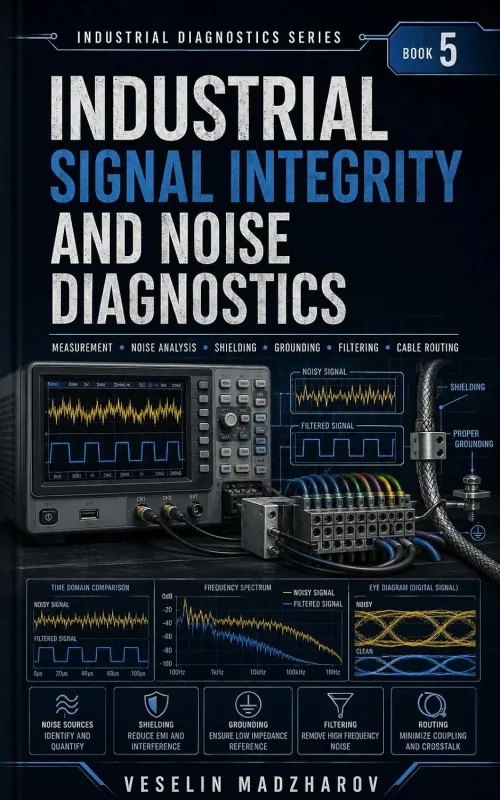
INDUSTRIAL SIGNAL INTEGRITY AND NOISE DIAGNOSTICS
EMC, Shielding, Ground Loops, Analog Drift, Encoder Errors and Communication Interference (Industrial Diagnostics Series Book 5)
Series: Industrial Diagnostics Series
A sensor can be perfectly healthy and still send an unstable signal. An encoder may lose pulses only when a motor starts. An analog value may drift without any obvious wiring fault. A communication network may report random errors even though every cable appears intact.
In industrial machines, electrical noise and signal-integrity problems are among the most difficult faults to diagnose because the symptoms often appear far away from the real cause.
INDUSTRIAL SIGNAL INTEGRITY AND NOISE DIAGNOSTICS is a practical guide to finding EMC, shielding, grounding, analog signal, encoder, and communication interference problems in real industrial systems.
Instead of treating every unstable signal as a failed sensor, PLC input, encoder, or communication device, this book shows how to trace interference from its source through the complete signal path and prove what is actually happening.
WHAT YOU WILL LEARN
• How electrical noise enters industrial control and measurement circuits
• How to distinguish a real process change from electrical interference
• How to diagnose unstable 0–10 V and 4–20 mA analog signals
• How ground loops create offset, drift, noise, and measurement errors
• How incorrect shielding can make interference worse instead of better
• How to diagnose encoder pulse loss, position errors, and intermittent feedback faults
• How VFDs, motors, contactors, braking circuits, and switching power devices generate interference
• How cable routing, separation, grounding, bonding, and shield termination affect signal quality
• How common-mode and differential-mode interference appear in real machines
• How poor 24 VDC distribution and reference potentials can corrupt signals
• How EMC problems affect PLC inputs, sensors, analog modules, encoders, remote I/O, and industrial networks
• How to investigate intermittent communication errors caused by electrical interference
• How to use multimeters, oscilloscopes, signal measurements, comparison tests, and controlled machine tests effectively
• How to locate the source, coupling path, and affected circuit instead of replacing components blindly
• How to verify that an EMC or shielding correction actually solved the problem
PRACTICAL ENGINEERING APPROACH
Noise source → coupling mechanism → cable or reference system → vulnerable signal → control-system symptom.
This method separates the source of the interference from the place where the fault becomes visible.
A VFD may generate the disturbance while an encoder reports the error. A poor PE connection may create a voltage difference while an analog input appears unstable. An incorrectly terminated shield may allow interference into a communication cable while the PLC reports only a network timeout.
These relationships are examined from a troubleshooting perspective.
Special attention is given to intermittent faults—problems that appear only during acceleration, motor starting, braking, contactor switching, welding operations, high machine load, or specific production conditions.
The material is manufacturer-neutral and applicable to production machinery, PLC systems, VFD installations, analog instrumentation, encoders, remote I/O, industrial Ethernet, fieldbus networks, control panels, and automated production lines.
WHO THIS BOOK IS FOR
• Industrial maintenance technicians
• Electricians and electromechanics
• PLC and automation technicians
• Controls and instrumentation engineers
• Commissioning engineers
• Engineers responsible for EMC and difficult intermittent faults
INDUSTRIAL SIGNAL INTEGRITY AND NOISE DIAGNOSTICS is Book 5 of the Industrial Diagnostics Series—a practical series focused on finding real faults in industrial electrical and automation systems.